After 35 Years in the Protection Dog Industry, I Have Noticed a Change

UK Security Concerns
Why are more families thinking seriously about their personal security?
After 35 years working with dogs and supplying trained family and personal protection dogs to clients around the world, you get used to having certain conversations.
People contact us for all sorts of reasons. Some have experienced a burglary. Some have been threatened or targeted. Others have a high public profile or a lifestyle that makes them feel particularly exposed. And many simply like the reassurance of having a properly trained dog in the family.
But over the last few years, I have noticed something changing.
It isn’t necessarily the number of enquiries. It is what people are saying to me when they call.
More and more, I hear variations of the same sentence:
“I just don’t feel as safe as I used to.”
These aren’t necessarily frightened people. Quite the opposite. Many are successful business people, professionals and families who have built very comfortable lives for themselves.
They aren’t panicking. They are reassessing.
And because I have been hearing it so regularly, not only from clients in the UK, but from people contacting us from different parts of Europe and further afield, I thought it was worth talking about.
Not to frighten anybody. Not to suggest Britain has suddenly become an extraordinarily dangerous place. And certainly not to sell protection dogs by scaring people.
In fact, if we’re going to have this conversation properly, we need to acknowledge something straight away.
The statistics don’t tell a simple story
If you relied solely on some social media channels, you could easily come away believing that crime in Britain is completely out of control.
The official figures don’t support such a sweeping conclusion.
The latest Office for National Statistics crime figures for England and Wales, covering the year ending March 2026, estimated 9.6 million incidents of headline crime. That was not a statistically significant change from the previous year’s estimate.
There is actually some encouraging news in the latest figures.
Police-recorded burglary fell 9%. Vehicle offences fell 11%. Robbery of personal property fell 9%. Knife or sharp-instrument offences fell 8%, and homicide was at its lowest level since current police recording practices began in 2003.
Those facts matter.
I’m certainly not going to cherry-pick statistics that suit my business while ignoring the ones that don’t.
But there is another side to this.
Only an estimated 36% of the headline crime incidents captured by the Crime Survey were reported to police, and the ONS itself cautions against using police-recorded crime alone to measure overall trends because reporting and recording practices change over time.
So the picture is more complicated than either “crime is spiralling out of control” or “crime is falling, therefore there is nothing to worry about.”
And perhaps statistics aren’t actually the whole point.
Feeling safe and being statistically safe aren’t quite the same thing
Security is an unusual thing.
Two families can live in exactly the same neighbourhood, facing broadly the same statistical level of risk, and feel completely differently about their security.
Something changes when the burglary happens three doors away rather than 100 miles away.
Something changes when somebody tries the handle of your car at two o’clock in the morning and you watch it back the next morning on your doorbell camera.
Something changes when somebody you know is followed home for their watch.
And something certainly changes if somebody actually enters your home.
That doesn’t necessarily alter the national crime statistics very much.
It can completely alter your perception of risk.
There are other reasons perceptions may have changed too. Confidence in local policing, for example, isn’t what it was a decade ago. In the year ending March 2025, 49% of Crime Survey respondents rated their local police as doing a good or excellent job, compared with 62% ten years earlier. Eleven percent reported seeing officers or PCSOs on foot patrol locally at least weekly, compared with 29% in 2015 and 39% in 2011. Office for National Statistics
That doesn’t prove somebody is less safe.
But I can understand why somebody might feel less reassured.
Wealth can also make you visible
This is another subject that needs some common sense applied to it.
Being successful doesn’t automatically mean you are going to become a victim of crime. Nor does living in an affluent neighbourhood.
But certain possessions inevitably advertise wealth.
An expensive car sitting on the driveway is visible.
So is a £50,000, £100,000 or £200,000 watch on somebody’s wrist.
And unfortunately there are criminals who deliberately target those things.
The National Crime Agency’s assessment of serious and organised crime specifically identifies luxury and high-performance vehicles as important targets for organised acquisitive crime. Recent cases demonstrate that this isn’t theoretical. In June 2026, two men were jailed for stealing 25 high-value BMWs and Mercedes worth more than £600,000 across several counties using relay technology.
The same applies to watches.
In one Metropolitan Police case, offenders carried out surveillance on members of the public before targeting them for high-value watches in Mayfair and Soho. And as recently as August 2026, plain-clothes officers in Mayfair intervened as a man attempted to take a Richard Mille watch valued by police at £250,000 from its wearer. Met Newsdesk
Again, I don’t mention those examples to frighten people.
They illustrate something I hear increasingly from clients:
“Am I more visible than I used to be?”
For some people, the answer probably is yes.
Our lives have become more visible as well
Thirty-five years ago, there was no Instagram.
There wasn’t Facebook, TikTok or the constant stream of photographs and videos showing where we are, what we’re doing, what we’re driving, where we’re holidaying and sometimes even the inside and outside of our homes.
Successful people have always owned nice things.
What’s changed is how much information we potentially make available about ourselves.
You can have an impressive house, a collection of cars and a beautiful lifestyle without doing anything wrong whatsoever. But it is reasonable to consider how visible that lifestyle has become and whether your security has evolved alongside it.
I sometimes put this another way:
Has your life changed faster than your security has?
Perhaps you bought the house 15 years ago.
Since then the business has grown. The cars have changed. The children have arrived. Your public profile has increased. You’re travelling more frequently. Your partner is sometimes home alone. And considerably more of your life is visible online.
Yet the security arrangements may essentially be the same as when you moved in.
That’s worth thinking about.
And what about changing neighbourhoods?
This is probably the most difficult part of this conversation, but avoiding it altogether would be dishonest because people raise it with me.
Some clients tell me their area or neighbouring areas has changed significantly and that they no longer feel as comfortable as they once did.
Sometimes they’re talking about antisocial behaviour. Sometimes increased traffic or people coming and going. Sometimes they’re talking about changes in the make-up of their community. Sometimes they simply say the area doesn’t feel like the place they moved into 15 or 20 years ago.
We need to be very careful here.
A change in the demographic make-up of an area does not, by itself, demonstrate an increase in crime, and I don’t think it would be responsible for me to suggest otherwise without evidence.
But people’s perception of their environment matters.
Communities change. Towns change. Cities change. People move in and out. Patterns of work, housing, policing and antisocial behaviour change.
And sometimes those changes cause people to reassess how comfortable they feel.
I’m not interested in turning that into a political argument.
I’m interested in listening to what clients are telling me.
After 35 years of talking to people about why they want a protection dog, I would be foolish to dismiss a change in those conversations simply because it is difficult to quantify.
Social media has changed our perception of crime too
There is another enormous difference between today and when I started A1K9.
We now see crime.
Doorbell cameras, CCTV and mobile phones mean incidents that would once have been known only to the victim, their neighbours and the police can now be watched by millions of people within hours.
Open Facebook or YouTube and you can see cars being stolen from driveways, shop thefts, street robberies, fights and attempted burglaries.
Some of that increased visibility is useful.
But it can also distort our perception.
Ten videos of burglaries appearing in your feed don’t mean ten burglaries happened in your street last night. Algorithms aren’t particularly interested in showing you the thousands of homes where absolutely nothing happened.
So again, I think balance is important.
Don’t assume everything you see on social media represents the country as a whole.
But equally, don’t tell people that what they are seeing with their own eyes, or experiencing within their own communities, is irrelevant simply because a national statistic happens to be moving in the opposite direction.
Both things can be true.
So where does a protection dog fit into all this?
This is perhaps where my view differs from somebody simply selling a security product.
I don’t believe everybody needs a protection dog.
A properly trained family protection dog is a considerable commitment. It needs to suit your family, your home, your lifestyle, your children, your other animals and your level of experience.
And a dog shouldn’t replace sensible security.
Good locks matter. Alarms matter. CCTV matters. Lighting matters. Gates and access control can matter enormously.
I see a trained protection dog as another layer.
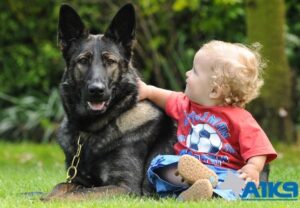
But it’s a rather unusual layer because when everything is fine, which, thankfully, is virtually all of the time that “security system” is lying on the kitchen floor, walking with you through the woods, playing with the children or asleep beside the sofa.
That’s what I have always believed a proper family protection dog should be.
A family dog first.
Stable, social, controllable and completely integrated into normal family life.
But if circumstances ever dictate otherwise, it possesses the training, confidence and ability to protect.
That distinction is enormously important to me.
The conversation has changed
When I look back over 35 years, I don’t think people have suddenly become paranoid.
I think they have become more conscious of security.
Some of that is undoubtedly because we are exposed to far more information about crime than previous generations ever were.
Some is because lifestyles have changed.
Some people are considerably more visible than they once were.
And yes, some forms of criminality have changed as technology, valuable assets and criminal methods have evolved. The fact that Parliament introduced new offences in 2026 specifically concerning electronic devices used for vehicle theft gives some indication of how seriously that particular problem is being taken. GOV.UK
But I think there is something more fundamental underneath all of it.
People want to feel safe in their own homes.
They want their partner to feel safe when they’re away.
They want their children to be safe.
And increasingly, the people I speak to aren’t waiting for something terrible to happen before asking whether the security surrounding their family is appropriate.
I don’t think that’s fear.
I think it’s a conversation worth having.
And after 35 years in this business, it is a conversation I’m hearing more often.
Charles Wall
Founding Director, A1K9